The Bike Plan Is Really About the Kind of Community We Want to Be
A position statement of the Friends of Lawrence Area Trails (FLAT)
— Chris Tilden, Board Chair
The public discussion surrounding Lawrence’s draft Bike Plan has largely focused on bicycles. That is understandable. It is right there in the title. But that framing misses the larger opportunity in front of us.
_____________________________________________________________________
This plan is not really about bicycles. It is about creating a more connected, healthier, and safer Lawrence.
_____________________________________________________________________
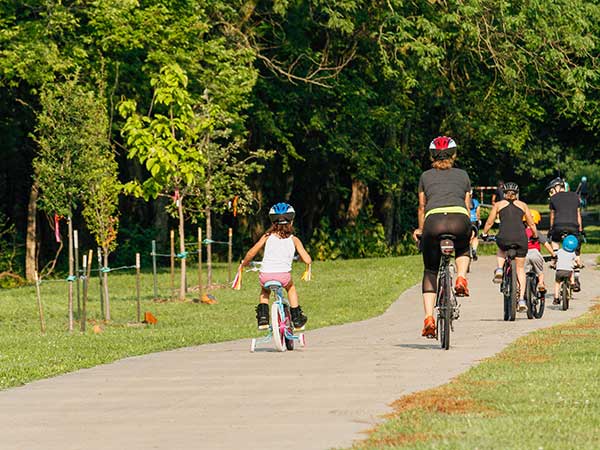
One of the things often lost in conversations about bike infrastructure is how much Lawrence residents value trails and active outdoor spaces. Community surveys have consistently shown that trails are used by a vast majority of Lawrence residents and are one of the most-used public amenities. Go out on any pleasant evening and you will see trails filled with walkers, runners, families pushing strollers, people walking dogs, older adults getting exercise, students heading to class…and yes, people on bikes.
These spaces are vital because they serve everyone. That is why FLAT supports the draft Bike Plan.
This is not because we are pushing everyone to ride a bike. We do believe, however, everyone deserves safe, comfortable ways to move through our community. We often hear critics ask a reasonable question: If bicycle infrastructure is so important, why don’t we see more people using the bike lanes we already have? The truth is, they are right. Many painted bike lanes appear underused. But why is that? The truth? Most residents are not comfortable riding a bike next to traffic moving 30 or 40 miles per hour with nothing separating them except a stripe of paint. The surprising thing is not that bike lanes seem empty, the surprising thing is that anyone uses them at all.
This very concept is highlighted in the draft Bike Plan. Residents repeatedly identified gaps in the existing bike network, stressful intersections, and other exposure to traffic as barriers to riding. When asked what kinds of facilities felt comfortable, respondents overwhelmingly preferred routes separated from traffic. In other words, people are acting rationally. Lots of people in Lawrence would like to walk, ride, and recreate more often; they simply do not feel safe doing so across much of our community.
_____________________________________________________________________
Unsafe conditions are a problem this plan attempts to solve. The goal is not to build infrastructure for the most confident cyclists. The goal is to create a network where a child riding to school, a retiree running errands, a college student getting to class, or a family out to experience nature would feel comfortable.
_____________________________________________________________________
The benefits Lawrence would experience by implementing the Bike Plan go far beyond bicycling. Connected trails and low-stress transportation routes provide recreational opportunities, they connect neighborhoods to parks, schools, businesses, and community destinations, and they offer transportation options for people who cannot drive, choose not to drive, or just want another way to get around. Safe bikeways, including trails, also make Lawrence a more attractive, healthy place to live. Like parks, libraries, and sidewalks, trails are public assets that contribute to quality of life for the entire community.
Another concern we hear about is cost. FLAT recognizes public resources are limited and every investment must be weighed against other priorities. However, many people assume bicycle and trail improvements are funded entirely through local tax dollars as stand-alone projects. This is rarely how these projects are delivered. In Lawrence, a majority of bicycle and trail improvements have been funded through competitive state and federal grants specifically intended for transportation safety, active transportation, and quality-of-life improvements. Other projects are built into road resurfacing or reconstruction projects at a small fraction of total project cost. Still others are built through private development as new neighborhoods, businesses, and community destinations are constructed.
Most of the time, the question is not whether taxpayers should fund a separate bicycle project with local tax revenues. The question is whether a road scheduled to be rebuilt should be designed using modern safety principles that make travel safer, more predictable, and more comfortable for everyone.
Good transportation infrastructure is not just about creating space for bicycles. It is about reducing conflicts between users and making expectations clear. When drivers and cyclists both know where they mutually belong and when crossings and other points of potential “conflict” are safer everyone benefits. Safer designs are not simply an investment in cycling. They are an investment in better-functioning streets.
_____________________________________________________________________
The draft Bike Plan is not a construction schedule, and it is certainly not a blank check. It is a roadmap that helps the community pursue opportunities as funding becomes available, roads are reconstructed, and other opportunities emerge. It helps ensure that when investments are made, they contribute to a connected system rather than a collection of disconnected pieces.
_____________________________________________________________________
Residents will disagree about individual projects, discussion that is healthy and a necessary part of civic discourse, but FLAT hopes we do not lose sight of the larger questions:
What kind of community do we want Lawrence to be?
Do we want a city where children can safely reach parks and schools? Do we want older adults to have comfortable places to walk and exercise? Do we want neighborhoods connected to one another by trails and shared-use paths?
Do we want streets that are safer and more predictable for everyone who uses them?
We believe most Lawrence residents would answer yes to all of those questions.
The Bike Plan will not be perfect, but implementing elements of the plan will move us toward a future where more people can safely enjoy the community we call home, and that is something we think we can all agree on.